The blade materials of kitchen knife are all based on martensitic stainless steel . The mechanical properties of this material can be adjusted by heat treatment, mainly by increasing its hardness and toughness. After more than a decade of continuous efforts, material manufacturers have developed different grades of materials suitable for different product unit prices and users through the research and development and comparison of cutting materials. Basically:
- Low-carbon steel
- Medium carbon steel
- High-carbon steel
- Multilayer steel
- Ceramic material
1. Low-carbon steel
A series of martensitic low carbon steels are represented by 1Cr10, 2Cr13, 3Cr13, 2Cr14, 3Cr14 and 4Cr14.
Take 2Cr13 as an example,the “2” represents 0.1-0.2% carbon content and “13” represents 12-13% chromium content. The higher the carbon content is, the higher the hardness is and the higher the chromium content is, the better the antirust ability is.
2. Medium carbon steel
5Cr15MoV is the representative of medium carbon steel, and the hardness after heat treatment is around HRC55-57 degrees. Because the material has a high carbon content, Mo (molybdenum) is added to increase its antirust ability and V (vanadium) is added to increase its toughness.
The element content of this brand is basically the same as that of German-made 1.4116 (X50CrMoV15, commonly known as 5Cr15MoV). The hardness of this material has reached the ideal state of kitchen knives, good toughness and durability, and ideal anti-rust ability.
Now Zwilling’s high-end knives basically use this brand (1.4116) material, and this material accounts for more than 75% of the knives we export to the European market, because the European market has a very high recognition of this material.
3. High carbon steel
8Cr14MoV, 9Cr18MoV, 10Cr18MoV is the representative of high carbon steel, and its hardness after heat treatment is more than 56 degrees.
Chinese 9Cr18MoV is suitable for outdoor knives (dagger, machete, etc.), its hardness can reach 60 degrees, the durability is good; 8Cr14MoV hardness can reach 57 degrees, toughness is good, durability is average, equivalent to 1.4116;
Italian 8Cr14MoVN hardness can reach 57 degrees, toughness is good, durability is a little worse than 440C, but the price is high.
Japan 440C (10Cr18MoV) hardness can reach 60-62 degrees, its anti-rust ability is good, toughness is good, has excellent wear resistance. To sum up, if you take the high-end product line, this material is the most ideal choice.
4. Multilayer steel
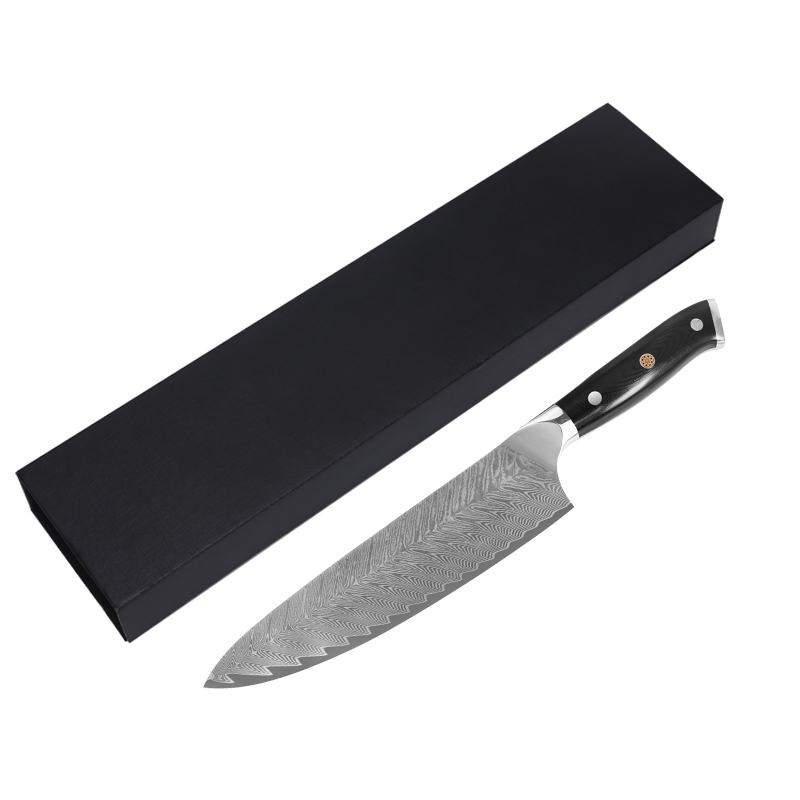
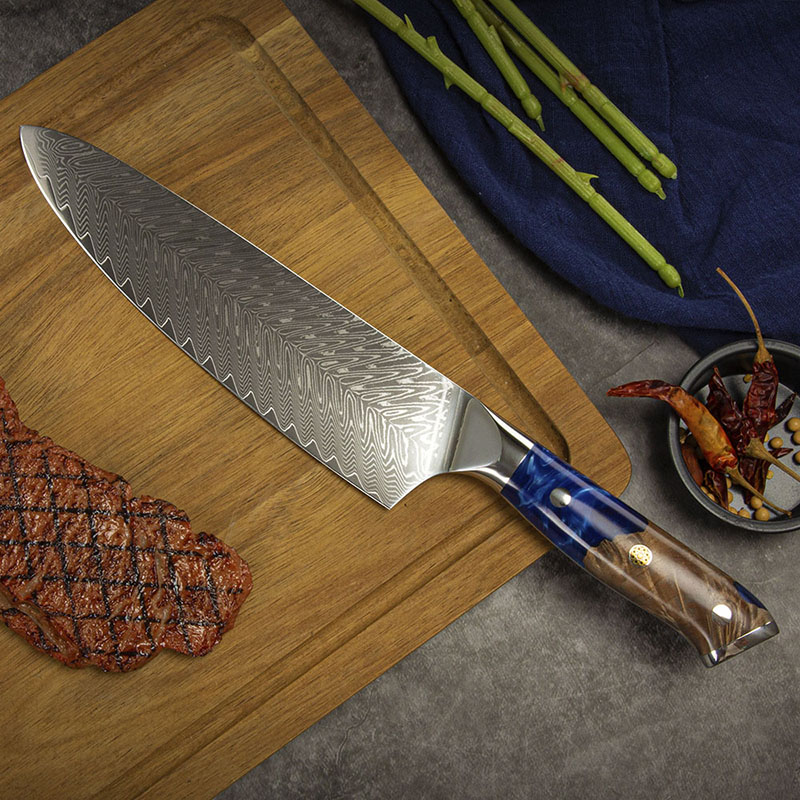
The general multi-layer steel has 3 layers, 17 layers, 33 layers and 67 layers. At present, most of the steel on the market are 3 layers of steel (called sandwich steel) and 67 layers of steel (called Damascus steel). No matter how many layers they are, it is only the middle layer that is actually used for cutting. The middle layer is usually made of high carbon steel 8Cr14MoV or 9Cr18MoV (Japanese VG10 or AUS8).
At present, there is no general international standard for this kind of steel, and there are several domestic enterprises producing this kind of special steel. Its leaders are Japan’s VG10 and Japan’s AUS8, but because of its limited production, VG10 and AUS8 are basically only used in the Japanese market. In order to promote and achieve the desired results, domestic businesses all indicate that the materials are VG10, but in fact they are all domestic.
Properties of materials
Because the multi-layer steel plate is formed by the fusing process, the cross section of the material will see the lamination effect. When machining the knives, the surface of the steel plate is rolled by different embossing moulds, after oblique grinding, and then through sandblasting or pickling treatment, the grain effect of the embossing die design will be shown on the blade surface.
Advantages
Because of the grain effect on the blade surface, and with the high cost of materials, it appears that the product is noble, which increases the collection value of the product and reflects the identity of the user.
Disadvantages
in order to make the grain exposed and the steel core wire on the left and right side of the edge as symmetrical as possible, the material is processed by hand. After repeated polishing, the crystal structure of the interlayer changes greatly, resulting in the hardness after quenching can not reach the original level (the hardness will be reduced to about 56 degrees). In order to achieve the symmetrical effect of steel core line, repeated polishing makes the angle of the edge too small (the ideal angle of the edge is 28-32 degrees, but the angle of the cutting edge of the Damascus knife is less than 26 degrees, which is very sharp at the beginning of use, but the durability is not good, and it is easy to roll the edge and cause it to become blunt.
5. Ceramic material
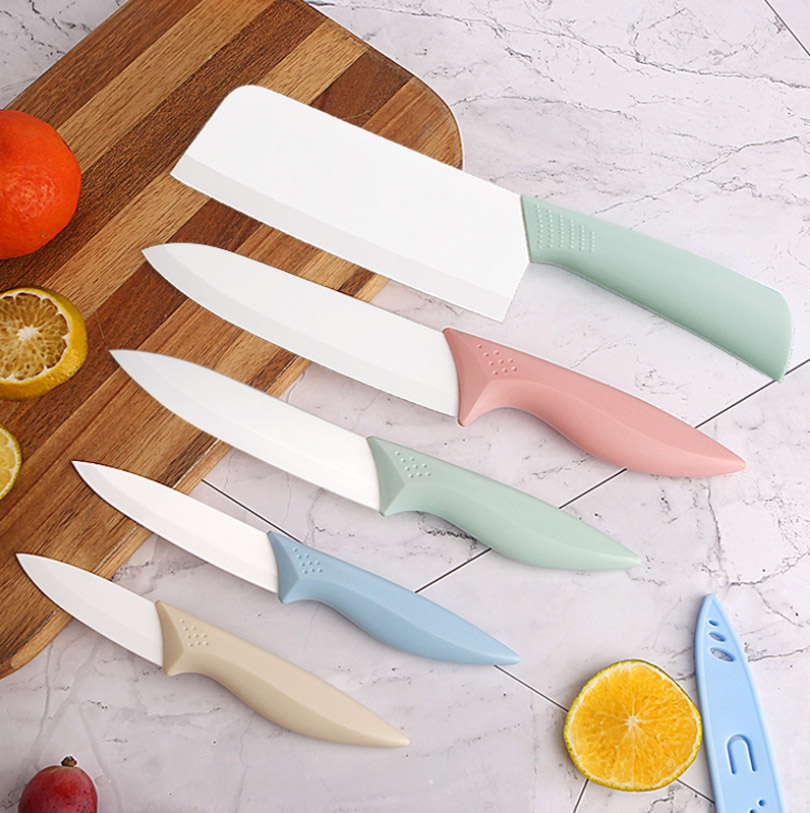
The blade material of ceramic knife is mainly zirconium dioxide, and its toughness is increased by adding yttrium dioxide.
Advantages and disadvantages
Its hardness is equivalent to the HRC 70-72 degrees, so the blade can be very sharp. The weight is relatively light, and it is generally equipped with plastic handle.
But because it is a ceramic type, brittleness is its Achilles’ heel. It is easy to break when cutting hard objects; rate breakage / fracture can not be avoided.
The blade surface is very easy to oxidize after contact with food materials or moisture, the original white ones will turn yellow, the black ones will darken and other bad effects on the surface.
So it can not be used routinely on the kitchen knife, usually in the form of fruit knife as a gift channel.